Agronomy
-
College
-
Hours Required
120 credit hours -
Minors Available
Agronomy
The Nebraska Difference
Individualized Advising
Undergraduate Research Opportunities
Hands-On Collaborative Learning
Program Features
Career Opportunities
Graduates pursue careers as agronomists, co-op and grain elevator managers, crop consultants, farmers, plant breeders and geneticists, field and lab researchers, soil conservationists and technical and sales representatives. Agronomy alumni enter in-demand fields with competitive salaries in a career field they love.
Local and Global Experiences
Students complete two internships before graduation, building professional networks and gaining hands-on experience in their field. Many students also participate in global experiences through UNL’s study abroad programs.
Scholarships
Scholarships are available to agronomy students at all stages, including incoming first-year and transfer students. The Department of Agronomy and Horticulture awards more than $170,000 in scholarships each year.
Notable Courses
Agronomic Plant Science Laboratory (PLAS 132)
Development and morphology of monocot and dicot plants produced for grain, forage and grazing. Evaluation of seeds, grains and forage quality for agronomically important plants.
Resource-Efficient Crop Management (PLAS 204)
The integration of crop and soil science, plant breeding, climatology and integrated pest management disciplines to develop and evaluate crop management strategies.
Principles of Soil Management (PLAS 269)
Current state-of-knowledge of soil and water management. Topics include soil management practices such as conservation tillage, cropping systems, water management and irrigation and soil health.
Forage Crop and Pasture Management (PLAS 240)
Plant identification and selection, seeding, fertilization, irrigation, forage quality and utilization, hay and silage preservation and grazing management.
Crop Management Strategies (PLAS 405)
Application, expansion and integration of principles from agricultural, economic and social sciences into systems-level development and management of cropping systems.
Site Specific Crop Management (PLAS 431)
Principles and concepts as well as hardware and software of site-specific management. Evaluation of geographic information systems for crop production practices.
The Science of Plant Variety Selection (PLAS 310)
Strategies for interpreting variety and hybrid testing data to match production goals and meet management challenges and priorities of the farmer.
Huskers Do Big Things
Internships
- Syngenta, Corn Production Internship
- BASF, Technical Service Intern
- Hahn Farms, Hybrid Researcher
- Scientific Crop Advisory, Crop Scouting
- Helena Chemical, Marketing Intern
- KC Consulting, Crop Consultant
Careers
- Stuart Fertilizer, Agronomist
- Vrbka Ag Solutions, Sales Agronomist
- NRCS, Soil Conservationist
- University of Nebraska–Lincoln, Research Technician
Graduate Schools
- University of Nebraska–Lincoln, Ph.D. in Plant Pathology
- Iowa State University, Master of Plant Breeding
- Montana State University, Master of Science in Plant Science
- Kansas State University, Ph.D. in Genetics
- Oklahoma State University, Ph.D. in Animal Science
Outside the Classroom
Agronomy Club provides educational and leadership opportunities while fostering a spirit of cooperation among students and faculty. Network and build connections for your future career experiences.
The University of Nebraska–Lincoln Crops Judging team is an extracurricular, intercollegiate contest team which competes at both regional and national Crops Judging contests.
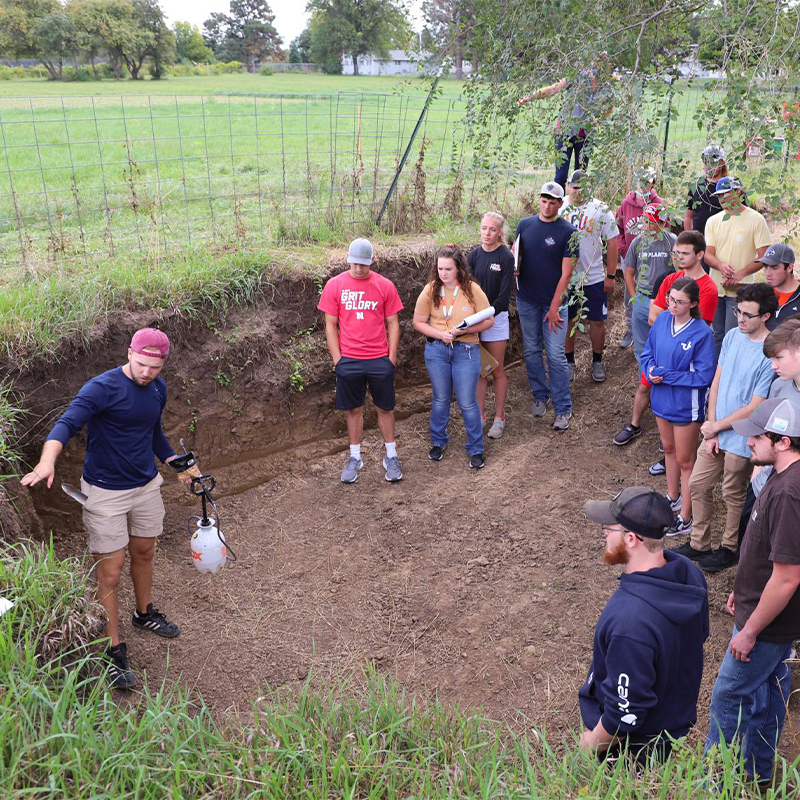
Soil judging provides an opportunity for you to study soils through direct experience in the field.
Students of the Weed Science Team compete in a contest hosted in association with the North Central Weed Science Society (NCWSS annually) and Weed Science Society of America.

Featured Faculty
Dr. Andrea Basche, Associate Professor
Dr. Basche focuses on cropping systems and teaches three undergraduate courses, including Resource Efficient Crop Management and Cover Crops in Agroecosystems. Her research interests involve soil health, water resources, human and policy dimensions of agricultural decision-making and agricultural systems modeling. Join Dr. Basche and her team in the Resilient Cropping Systems Lab to build a more equitable and sustainable food system.
Have Questions? We're Here to Help
If you have questions about the Agronomy major or navigating the application process, contact us.

- Contact Name
- Christine Barta
- Contact Title
- Plant Systems Learner and Partnership Engagement Coordinator
- Phone
-
-